
A Turning Point
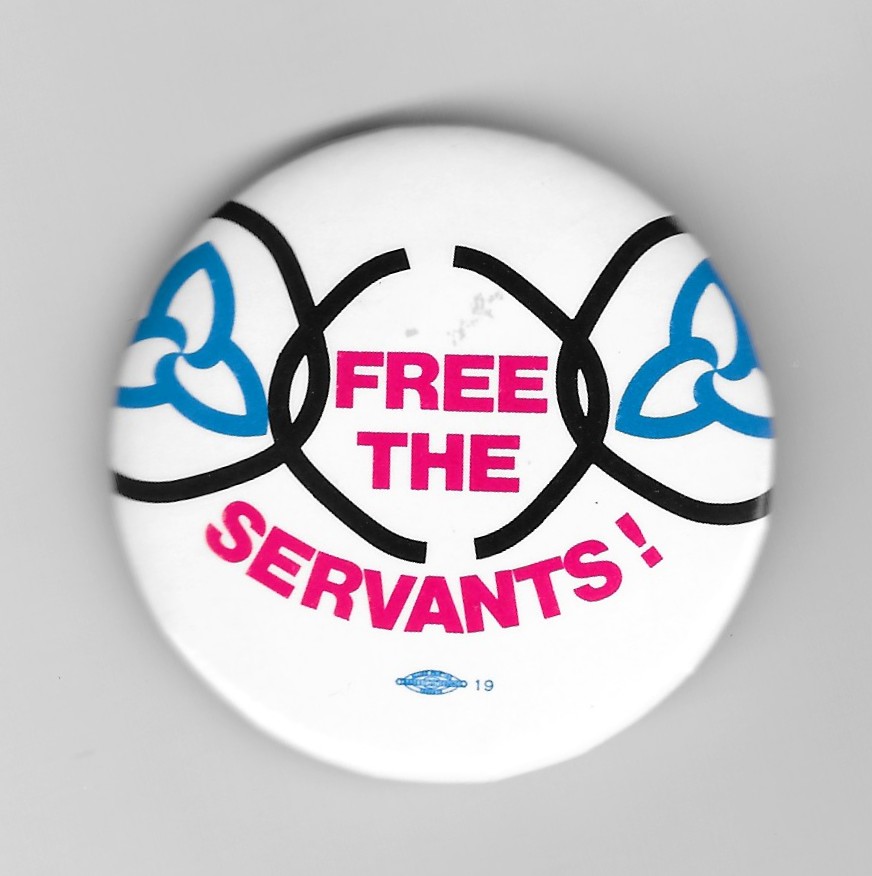
The strike that I most vividly recall wasn’t even one of “ours.” It belonged to Seneca’s Support Staff (OPSEU Local 561) and support staff workers across the province. In 1974, the Conservative government of the day had introduced the Crown Employees Collective Bargaining Act which was one of the most brutal anti-labour laws of its time. It sparked a massive reaction led by the CSAO (precursor to OPSEU). The anti-CECBA campaign dubbed “Free the Servants” fulfilled the promise of President Charlie Darrow: “we will no longer sit meekly at the feet of the almighty and accept the condescending paternalism of the employer.”
While wrangling over modifications of CECBA, Premier Davis had to deal with the colleges. He wanted us off his back and chose to draw up new legislation for the colleges alone. Writes Wayne Roberts: “New college legislation was drawn up on the run, closely modelled on the law for high school teachers, and sped through the legislature… it got the same legislative guarantee of scab-free strikes as teachers.”
One more step was needed. In bargaining, the college support staff gave equal representation to technicians, maintenance, and clerical staff, even though the male-dominated technicians and maintenance staff combined to constitute only one-third of the membership. Northern College’s Larry Sauer explained that “technicians were the prima donnas on the team… They had ‘issues.’ Janitors had ‘problems.’ Women had ‘complaints.’”
Led by Algonquin College’s Bev Allan and Seneca’s Susie Vallance, the membership defied their Bargaining Team’s recommendation to accept a negotiated settlement. So, in January 1979, the first strike CSAO’s history began.
Seneca faculty helped by carrying out picket duty on weekends. I’d spent time under picket signs in support of Martin Luther King’s Selma March in 1965 and in opposition to US bombing Cambodia in 1970, but it wasn’t until Local 561 went on strike that I felt the pain of being run down by an AMC Pacer at the entrance to the Finch Campus, deposited about 100 feet into the campus, and eventually transported to North York General Hospital for repairs. I was soon given a lesson in the politics of the picket line. The police did not charge the driver with making an illegal turn, failing to yield to a pedestrian, or leaving the scene of an accident. The case was transferred from accident investigation to labour relations and quietly buried.
The strike did not immediately produce tremendous results; however, as my old friend and retired OPSEU staffer, Bob Hebdon, put it, “it was a success story of maturity and self-reliance.” Until 1979, said Susie Vallance, “management treated us with contempt, and it got to the point where we said we’re not going to take it. You had to be in that room to watch that mood. ‘F— you, we’re going on strike!’”
It marked a change of attitude—a recognition that there was an inherently adversarial relationship between the employer and the employees. While we were engaged in a common project, the education of our students, we came to understand that a line had been drawn or, rather, we saw clearly and perhaps for the first time, the line that had always been there.
It was a baptism of fire for OPSEU and for the support staff workers. Our Local 561 colleagues showed us the way. At the next Convention, support staff persuaded the Union to establish a formal strike fund and central operating procedures. Lessons were learned at all levels. Thanks to support staff, the strike became a central tactic in negotiations. College employees learned that we could stand up for ourselves. The next support staff negotiations won a 15% wage increase and a dental plan.
In 1984, it was faculty’s turn. We conducted our first strike. It would not only be successful, it would be transformative.