
MOVING TOWARD MILITANCY
By the 1970s, changes in employer/employee relations in the colleges and the larger Ontario public sector were afoot. Rigid authoritarianism was replacing patrician administration; worker solidarity was intensifying.
There was also internal turmoil at CSAO, the “company union.” Internal factions battled. Conspiracies, cunning plots, and occasional coups guaranteed heaps of drama.
I am delighted to report that it ended in a remarkable transformation. The old “old guard” was replaced by a new “old guard,” which succumbed (albeit narrowly) to a yet more militant generation that gained control in 1974 when CSAO held its last convention and OPSEU was officially born.
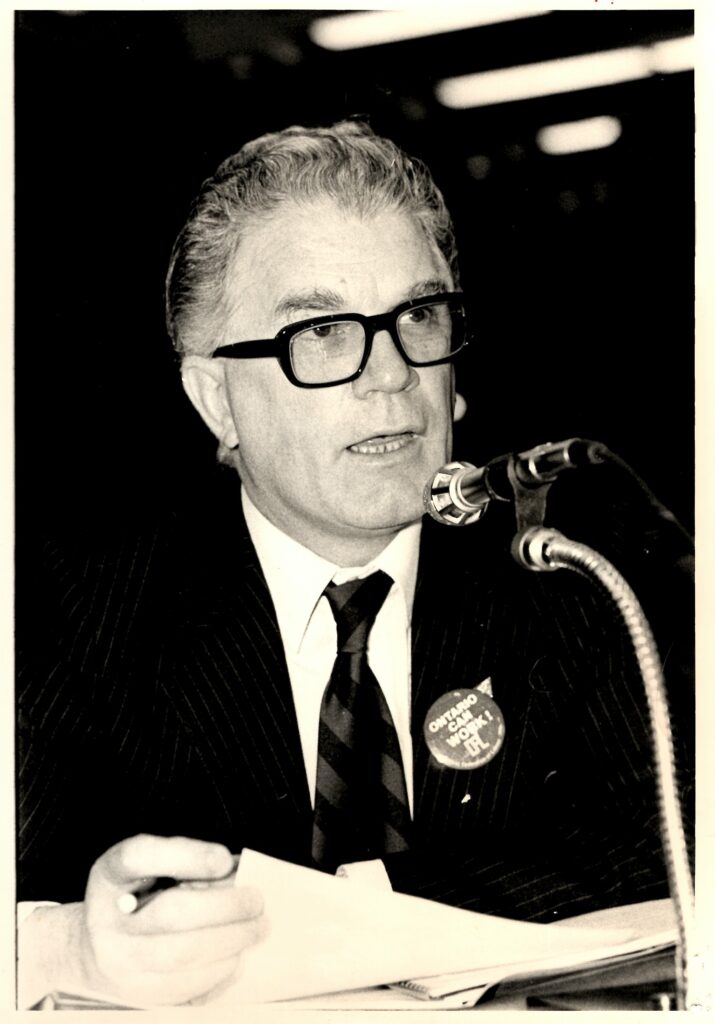
Predictably, ex-Senecan Frank Eastham was instrumental in the reorganization. In sequence, he was Executive Assistant to autocratic General Manager Jake Norman, democratic President Charlie Darrow, and socially progressive president (and Niagara College professor) Sean O’Flynn. The transformation process was complete when O’Flynn won to the presidency in 1978 by a narrow six votes.
A former coal miner, Catholic novitiate, Oxford scholar, and future abstract artist, Sean guided the change by precept and example. He stressed democratic activism, wanting members to “run their union” and “to rely on their own skills and the strength of their fellow workers to stand up to the boss.”
Inspired by Walter Reuther’s United Auto Workers, among the more progressive unions in American labour history, Sean acknowledged that “it was a hard gospel to sell in a civil service union” whose members were used to the union as a “servicing organization,” not a “tool of empowerment.”
Sean led by action. In 1980, he served 23 days in the Metro West Detention Centre for “contempt of court” following his role in a corrections officers’ “wildcat” strike. In 1981, when Centennial College laid off 47 maintenance workers and contracted the work out, O’Flynn, Ontario Federation of Labour Secretary-Treasurer Terry Meagher, Toronto Labour Council President Wally Majesky, and two Local 558 activists, Ross Morra and Jeff Hartman, occupied the office of Centennial’s president. After eight days, the college agreed to save the jobs.
Wayne Roberts summarized:
While the union was looking for ways to get more power at the workplace and bargaining table, OPSEU was becoming one of the most dynamic forces for social change in the province. A new brand of social unionism developed… during Sean O’Flynn’s years as president… OPSEU’s social unionism focused on social legislation with immediate playback in the workplace. It started to bridge those divisions… that separated government policy, community need, and public sector work.
Staffer André Bekerman explained that social action had to be welded to hard wage bargaining: “You don’t move employers by eloquent arguments and appeals to heartstrings. You move them by grabbing them where it hurts. You drive wages down their throats… As long as they can get away with paying you badly, they’ll pay no attention to other problems you’ve got, because in their minds if you’re a low-paid worker, you can’t be worth much, and your problems can’t be worth much.”
It’s a lesson college faculty learned well. It led into our first “inflection-point,” the strike and settlement of 1984.
(Full disclosure: In 1982, I was honoured to be Co-chair, with future OPSEU president Jim Clancy, of the Committee to Re-elect Sean O’Flynn OPSEU President.)