
WHAT NORTHROP FRYE SAID
As a postsecondary student, the only English course I took was the mandatory first-year “Intro” required of York University students in its opening year as an independent institution (1963).
I got a C+.
By mutual agreement, I never darkened the door of an English Department again.
Consequently, I first heard of Northrop Frye in my third year as a full-time faculty member at Seneca, when I read his Letter to the Editor (Toronto Star, March 24, 1972). Therein, he complained about The Wright Report—one of many bureaucratic recommendations for change in Ontario higher education.
A statue of the far-famed Frye now sits on the St. George Campus. It looks quizzically at passers-by—seemingly wondering if his literary theories and criticism remain influential.
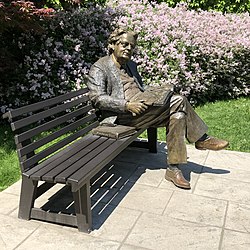

Perhaps he’s better off not knowing. Besides, despite his intellectual achievements, I consider him to be one of us.
He said this to Star’s readers:
In attempting to read the draft report of the Wright Commission, I found myself baffled so often by the prose of its ‘aims and objectives’ section that I finally started reading it at the other end.
There I discovered on the last page that, for teaching in universities, one hour of ‘contact’ with students would require two hours of ‘preparation,’ hence a teaching schedule of 13 hours a week would give one a 39-hour week. As this two hours of preparation is evidently intended to include marking and interviews as well, that leaves about one hour of preparation for each hour of lecturing.
For the information of the commission, it takes about 10 hours a week for every hour in the classroom, if that hour is to be of any conceivable use to students. A good deal of this time would be spent in what the commission calls ‘research,’ and which it evidently regards as something different from working on one’s teaching. I have never found, in over 30 years of teaching and writing, that I could separate the two activities. Students can read. What is the point of lecturing to them at all unless one has something to give them that they can’t get as easily in books?
This point has, with a great many others, been dealt with in the University of Toronto Faculty Association brief. But it seemed to me to provide a central clue to the thinking that underlies the report.
Of course it is possible, in teaching such a subject as English literature, to pick out a good secondary source and memorize enough of it in an hour to get through another hour talking about it. That is sometimes done by overworked junior instructors or uninterested older ones, but if persisted in it becomes dishonest. But, of course, it is emphatically not ‘elitist’; it would reduce all university teaching to the level of an 18th-century school. Consequently, it appears, it would fit very well into the ‘aims and objectives’ of this commission.
It is a historic moment when a report on education concludes by taking an occasional abuse or corruption of the teaching practice in universities and proposes to make it the norm of procedure. That is why I think this casual footnote in the report is so crucial: if the commission can get the central fact of university procedure so wrong, how can we believe or trust anything else it says?”
We don’t teach in a university. Most of us don’t teach English. Our curricula, our methods, and our students are not the same as Professor Frye encountered fifty years ago. But Plus ça change, plus c’est la même chose. None of us can trust what the employer tells us about our work either.
Full-time faculty work well beyond what the full-time SWF provides (and PL and PT people are treated worse).
Why did the SWF seem like a victory in 1984?
I’ll deal with that in the seventh installment.